Academic and Engineering Walkthrough
“Do not merge this PR: tests are failing.” Formally, there is no complete deduction here. Why do failing tests prohibit a merge? Because the team accepts a hidden rule:
PR с непройденными обязательными проверками не мержат.
У этого PR не пройдены обязательные проверки.
Следовательно, этот PR не мержат.
Ordinary speech is almost always enthymematic. If one requires stating every
premise, conversation becomes impossible. The task of logic is not to prohibit
abbreviations, but to learn how to expand them in controversial places.
Chapter Rule
Reconstruct the minimal premise that makes the argument strong and fits the context. Then check it exactly.
1. The Enthymeme in Aristotle
In “Rhetoric” Aristotle connects:
- example with rhetorical induction;
- enthymeme with rhetorical syllogism.
An enthymeme is usually shorter than a strict proof because the audience itself
adds a known or plausible premise. This is not just a “syllogism with a missing line”: rhetorical reasoning works with what is considered
acceptable for a particular audience and in questions where different outcomes are possible.
2. Three Abbreviations in Chelpanov
Chelpanov shows three ways to reduce:
Большая посылка: Все M есть P.
Меньшая посылка: S есть M.
Заключение:      S есть P.
Missing Major Premise
Этот релиз нельзя выпускать, потому что обязательная проверка не пройдена.
Hidden:
Релизы с непройденной обязательной проверкой выпускать нельзя.
Missing Minor Premise
Этот релиз нельзя выпускать, потому что релизы с непройденной обязательной
проверкой выпускать нельзя.
Hidden:
У этого релиза проверка не пройдена.
Missing conclusion
Релизы с непройденными проверками не выпускают, а у этого релиза проверка
красная...
The pause offers the audience to complete the inference.
3. Why We Omit Premises
- Common knowledge. “It’s raining outside — take an umbrella.”
- Attention economy. The full form would repeat the team’s rules.
- Politeness. The conclusion is left to the interlocutor.
- Emotional effect. Incompleteness enhances engagement.
- Hiding the controversial. The most important premise disappears from the scope of verification.
Last case:
Users must not be allowed to export: this is personal data.
Possible hidden premise:
Any operation with personal data is prohibited.
It is false. A correct model asks about the grounds for processing, purpose, composition,
access, localization, time limits, logging, and the subject’s rights.
4. Reconstruction Algorithm
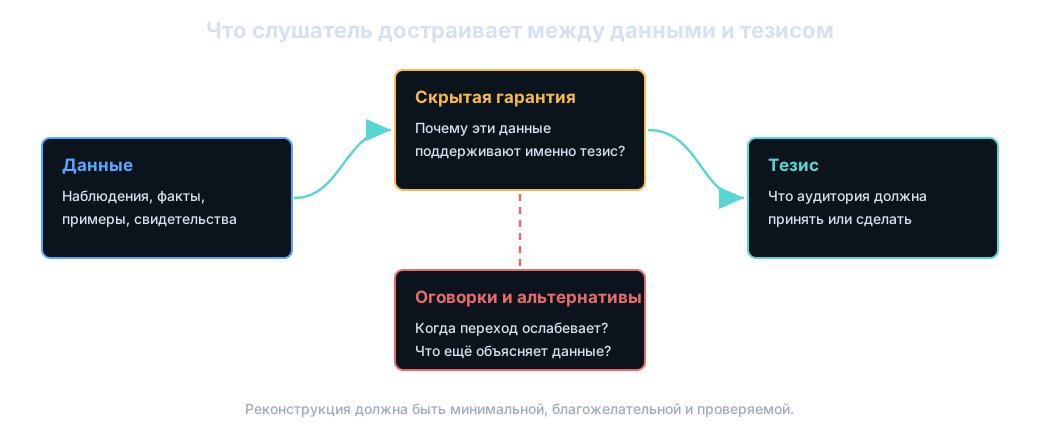
Step 1. Find the stated thesis
Not the topic “about microservices”, but a proposal:
Команде не следует выделять Billing в отдельный сервис в этом квартале.
Step 2. List explicit grounds
Граница Billing менялась четыре раза за полгода.
Команда состоит из четырёх инженеров.
Независимое масштабирование пока не требуется.
Step 3. Ask “why this supports the thesis?”
Candidate for a hidden rule:
Если граница нестабильна, команда мала, а независимое масштабирование не
требуется, цена раннего выделения обычно выше ожидаемой выгоды.
Step 4. Make the rule minimal
Do not add:
Микросервисы всегда плохи.
This is stronger than necessary and turns a reasonable local argument into a caricature.
Step 5. Check compatibility with the author’s speech
If there are multiple reconstructions, ask a question:
Did I understand correctly that the main criterion is an unstable boundary and
lack of independent scaling, rather than a ban on microservices altogether?
Even if a rule makes a transition valid, it may be a weak empirical generalization.
5. Principle of Benevolence and steelman
Principle of charity offers to choose a reasonable interpretation
compatible with the text and context. Steelman goes further: builds the strongest
version of the position that a competent supporter could defend.
Constraints:
- you cannot replace the real position with a new one;
- you cannot hide that the formulation has been improved;
- in requirements auditing, the author’s accuracy is more important than the philosophically better thesis;
- in security, a “good guess” does not replace clarification.
Useful markup:
Автор сказал: ...
Я восстанавливаю скрытую посылку так: ...
Сильнейшая разумная версия была бы: ...
6. Transition Guarantee
Modern argumentation theory often calls the hidden common rule
guarantee (warrant):
Данные ──[гарантия]──> Тезис
Example:
Данные:
    В трёх последних релизах ошибка сериализации возникла после изменения
    схемы без backward compatibility.

Гарантия:
    Повторяющийся механизм в сопоставимых условиях повышает вероятность той
    же причины.

Тезис:
    Сначала проверить несовместимость схемы.
This is abductive, not deductive, inference. A disclaimer is needed:
если профиль ошибки и путь данных сопоставимы
7. Example as rhetorical induction
Aristotelian example transfers knowledge from one case to another or from
several cases to the general.
Команда A отделила сервис до стабилизации границ и получила распределённый
монолит.
Команда B сделала то же.
Нам тоже стоит отложить выделение.
Checks:
- Are the cases indeed similar by relevant criteria?
- Are only failures selected?
- Are there counterexamples?
- Is the transfer mechanism clear?
- Does the strength of the conclusion match the number and quality of examples?
An analogy does not have to be deductive to be useful. It should show
relevant structural similarity.
8. Sign and Necessary Criterion
In “Rhetoric” the difference between is important:
- an indicator making the inference probable;
- a necessary sign ensuring a stronger transition.
Высокий CPU может быть признаком нагрузки.
OOM kill — более прямой знак исчерпания памяти процессом, но тоже требует
контекста cgroup и системных логов.
A fallacy occurs when a probable sign is taken as a definite cause.
9. Maxim
Maxim — a general statement about choice or behavior:
Измеряй прежде, чем оптимизировать.
A maxim with an explanation becomes an enthymeme:
Не оптимизируй этот участок до профилирования: без измерения мы не знаем,
является ли он ограничением.
Maxims compress experience, but easily turn into absolutes:
- “DRY” does not prohibit intentional duplication;
- “You build it, you run it” requires resources and authority;
- “move fast” does not define an acceptable risk.
10. Logos, ethos and pathos
Three persuasion methods cannot be divided into “logical” and “fallacious”.
Logos
Argument structure, data, and transition.
Ethos
Ground for trusting the speaker’s competency and integrity.
Эксперт по PostgreSQL сообщает о редкой аномалии конкретной версии.
This is relevant evidence if:
- competency area matches;
- assertion is conveyed accurately;
- there is no stronger available evidence;
- trust does not turn into infallibility.
Pathos
Working with emotions and significance. In the story about the leak, the real consequences for
people help correctly assess the severity of the risk. The error begins when emotion
replaces the missing link or intentionally blocks the check.
11. Common Hidden Premises
Norm
Это нарушает style guide, значит, надо исправить.
Hidden: style guide rules are mandatory and applicable here.
Reason
После деплоя выросли ошибки, значит, виноват релиз.
Hidden: there were no other changes capable of explaining the growth.
Classification
Это персональные данные, значит, нужен такой процесс.
Hidden: the object falls under a specific legal regime and process.
Forecast
Команда раньше срывала сроки, значит, сорвёт и этот.
Hidden: the conditions and delay mechanism remain.
Value
Решение увеличит конверсию, значит, его надо выпускать.
Hidden: conversion growth outweighs risk, cost, and other values.
12. How Weakness Is Hidden
Passive Voice
Считается, что архитектура масштабируема.
Who is considered and on the basis of what?
Nominalization
Произошло улучшение эффективности.
Which metric, with respect to what, measured by whom?
Unclear “obvious”
Очевидно, что пользователю нужен AI.
“Obviously” often guards a weak premise from questioning.
Built-in presupposition
Когда вы перестанете игнорировать безопасность?
The question presupposes that neglect occurred.
13. Practice: RFC
Original phrase:
Use Kafka because we need reliability.
Reconstruction 1:
Системы на Kafka надёжны.
Нам нужна надёжность.
Следовательно, нам нужна Kafka.
Invalid form: affirmation of the consequent / undistributed middle.
Strong version:
Требования:
    переживать краткую недоступность consumer;
    повторно доставлять события;
    независимо масштабировать чтение;
    хранить историю N дней.

Данные:
    Kafka поддерживает durable log, consumer offsets и replay в наших
    эксплуатационных ограничениях.

Оговорки:
    команда умеет её эксплуатировать; стоимость кластера приемлема; exactly
    once не предполагается.

Вывод:
    Kafka — один из подходящих кандидатов; сравниваем с managed queue и
    transactional outbox по таблице решений.
Now the argument allows checking.
14. Reconstruction checklist
- Is the thesis stated in one sentence?
- Are the explicit premises separated from the conclusion?
- Which “why?” question reveals the bridge?
- Is the hidden premise minimal?
- Does it correspond to the author’s words and context?
- Has a local recommendation not turned into a universal prohibition?
- Is the hidden premise factual, normative, causal, or valuational?
- Can the author be asked instead of guessing?
- Is the strength of the conclusion indicated: necessarily, probably, plausibly?
- Does reconstruction help improve the argument, not defeat the person?
15. Tasks
Restore at least two possible hidden premises and choose the most
benevolent one:
- “Do not hire this candidate: he did not ask any questions.”
- “Rewrite it in Rust — crashes will disappear.”
- “This metric cannot be used: it is vanity.”
- “We do not need a threat model, the product is internal.”
- “The article deserves trust: it is published in a good journal.”
For each case, indicate which evidence will check the hidden premise.
Sources
What’s next
We are able to see the missing bridge. Now let us return to the first systematic
catalogue of imaginary proofs: linguistic and non-linguistic fallacies of Aristotle.
Aristotle’s Thirteen Fallacies

