Academic and Engineering Walkthrough
Aristotle’s syllogistic was the central tool of deduction for more than two thousand years. Modern predicate logic is more expressive, but the categorical syllogism remains a good trainer for form, term extension, and counterexamples.
Все сервисы с публичным API документированы.   большая посылка
Billing имеет публичный API.                   меньшая посылка
Следовательно, Billing документирован.         заключение
2. Three Terms
In conclusion:
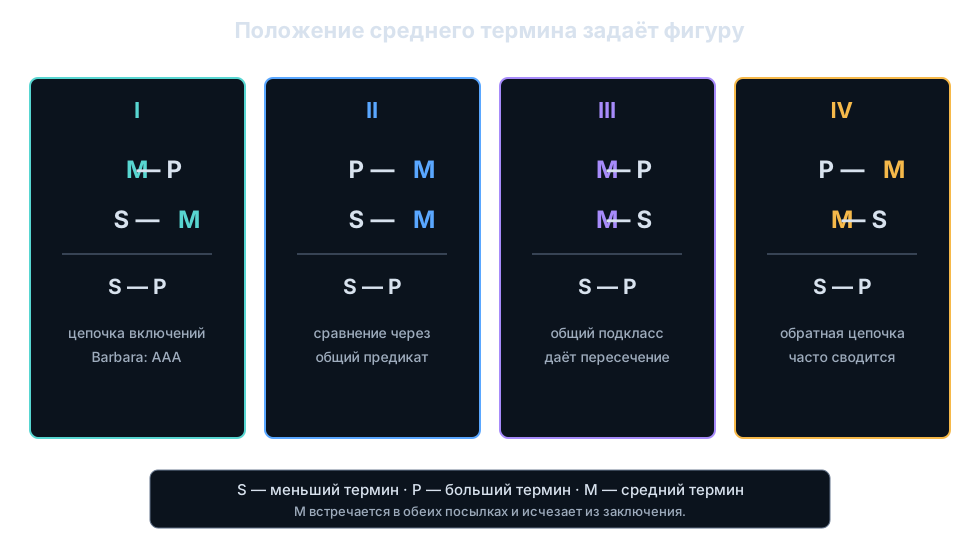
S — minor term, subject of the conclusion;P — major term, predicate of the conclusion;M — middle term, present in the premises and absent in the conclusion.
Example:
Все M есть P.       Все публичные API документированы.
Все S есть M.       Billing — публичный API.
Все S есть P.       Billing документирован.
The middle term публичный API carries the relation from Billing to
documentedness.
The figure is defined by the position of the middle term.
| Figure |
Major premise |
Minor premise |
Intuition |
| I |
M–P |
S–M |
inclusion by chain |
| II |
P–M |
S–M |
comparison of two classes by predicate |
| III |
M–P |
M–S |
inference about intersection through common subclass |
| IV |
P–M |
M–S |
reverse chain, usually requires transformation |
Aristotle systematically considers the first three; the fourth is formulated in
the later tradition.
4. Mode
The mode is defined by the types of three judgments A/E/I/O:
means two universal affirmative premises, a universal affirmative conclusion and the first
figure.
Barbara: AAA-1
Все M есть P.
Все S есть M.
Следовательно, все S есть P.
Multiple model:
Celarent: EAE-1
Ни одно M не P.
Все S есть M.
Следовательно, ни одно S не P.
Darii: AII-1
Все M есть P.
Некоторые S есть M.
Следовательно, некоторые S есть P.
Ferio: EIO-1
Ни одно M не P.
Некоторые S есть M.
Следовательно, некоторые S не P.
Names encoded operations of reducing modes to the first figure. It is not necessarily
to memorize them; it is more useful to be able to restore the form.
5. General Rules of Syllogism
Rule 1. Exactly Three Terms
If a term changes its meaning, formally there are four of them:
Все баги надо исправлять.
Жук — bug по-английски.
Следовательно, жука надо исправлять.
Two bug values do not form one middle term.
Rule 2. The middle term is distributed at least once
Все backend-разработчики — программисты.
Все frontend-разработчики — программисты.
Следовательно, все frontend-разработчики — backend-разработчики.
Программисты — predicate of two A-judgments and not distributed anywhere. Both classes
may be different parts of a large class of programmers.
Rule 3. The term is not distributed in the conclusion for the first time
One cannot infer about the whole class if the premises spoke only about a part.
Все архитекторы — инженеры.
Ни один дизайнер не архитектор.
Следовательно, ни один дизайнер не инженер.
In conclusion инженеры are distributed by form E, while in the A-premise the predicate
инженеры is not distributed. Designers can be engineers of another type.
Rule 4. No conclusion follows from two negative premises
Ни один S не M.
Ни один P не M.
We know only that both classes lie outside M; they can relate to each other in any way.
Rule 5. With a negative premise, the conclusion is negative
And vice versa: a negative conclusion requires a negative premise.
Rule 6. A necessary conclusion cannot be drawn from two particular premises
Two unknown class fragments may not have the required common object.
Rule 7. A particular premise does not lead to a general conclusion
Information about a part does not allow claiming for the entire class.
Rule 8. Watch for existence
Some traditional modes derive a particular conclusion from universal premises
and therefore require a non-empty class.
6. Valid Modes and Existential Clause
Practical set:
| Figure |
Unconditionally valid in modern interpretation |
With the existence of a class |
| I |
Barbara, Celarent, Darii, Ferio |
Barbari, Celaront |
| II |
Cesare, Camestres, Festino, Baroco |
Cesaro, Camestrop |
| III |
Disamis, Datisi, Bocardo, Ferison |
Darapti, Felapton |
| IV |
Camenes, Dimaris, Fresison |
Bramantip, Fesapo, Camenop |
Lists in textbooks vary because:
- traditional logic assumes the existence of certain classes;
- the modern Boolean interpretation of universal judgments does not assume;
- some authors include weakened modes, some — only the main ones.
Therefore, the number of “valid modes” without specifying semantics is misleading.
7. Check via Venn diagrams
For three terms, three intersecting circles are drawn.
Rules:
- a universal premise shades an empty area;
- a particular one places
× in an area where there is an object;
- if after applying the premises the conclusion is already depicted, the form is valid;
- if it is possible to place objects so that the premises are true and the conclusion
false, this is a countermodel.
Barbara
Все M есть P  → заштриховать M вне P.
Все S есть M  → заштриховать S вне M.
After this the S area outside P is empty, meaning all S is P.
Undistributed Middle
Все S есть M.
Все P есть M.
S and P can be placed in different parts of M. Intersection is not enforced.
8. Check by translating into predicate logic
Barbara:
∀x(Mx → Px)
∀x(Sx → Mx)
────────────────
∀x(Sx → Px)
Take an arbitrary a:
- assume
Sa;
- from the second premise we get
Ma;
- from the first —
Pa;
- therefore,
Sa → Pa;
- generalize over
a.
Syllogistics becomes a fragment of first-order logic.
9.1. Four Terms
Ambiguity creates two middle terms.
Ничто лучше счастья.
Бутерброд лучше, чем ничто.
Следовательно, бутерброд лучше счастья.
Ничто in the first phrase — negative quantifier, in the second — comparison object.
9.2. Unassigned Average
Все успешные команды общаются.
Наша команда общается.
Следовательно, наша команда успешна.
Communicate and unsuccessful teams.
9.3. Illicit Expansion of the Major Term
That is the “architects / designers / engineers” example above.
9.4. Illicit Expansion of the Minor Term
Все S есть M.
Все M есть P.
Следовательно, все P есть S.
The conclusion applies to the entire P, although the premises do not provide this.
9.5. Two Negative Premises
Two classes are separated from the third only.
9.6. Affirmative conclusion from a negative premise
The gap between classes cannot give rise to positive inclusion without other
information.
9.7. Existential error
Все perpetual motion machines энергоэффективны.
Все perpetual motion machines бесшумны.
Следовательно, некоторые бесшумные вещи энергоэффективны.
If there are no such machines, the private conclusion is not guaranteed.
10. Conditional and Disjunctive Syllogisms
They are not categorical, but a traditional course considers them alongside.
Modus ponens
Modus tollens
Hypothetical syllogism
Disjunctive syllogism
For the inclusive “or” the form is valid. And here:
Valid only for exclusive “or”.
11. Sorites, polysyllogism and chains
Polysyllogism — a chain in which the conclusion of one syllogism becomes the premise
of the next.
Все canary-релизы ограничивают blast radius.
Все релизы сервиса X — canary.
Следовательно, релизы X ограничивают blast radius.

Всё, что ограничивает blast radius, снижает ожидаемый ущерб ошибки.
Следовательно, релизы X снижают ожидаемый ущерб ошибки.
Sorites shortens intermediate conclusions:
S ⊆ M1
M1 ⊆ M2
M2 ⊆ P
∴ S ⊆ P
The longer the chain, the higher the chance of a hidden change in meaning.
12. Engineering example: “all fast services use cache”
Все быстрые сервисы используют кэш.
Catalog использует кэш.
Следовательно, Catalog быстрый.
Form:
Все P есть M.
S есть M.
∴ S есть P.
The middle term M is not distributed. Countermodel: a slow service also uses
a cache, because the database is even slower.
Repair:
После включения кэша при неизменной нагрузке p95 Catalog снизился с A до B;
контрольная группа не изменилась. Кэш, вероятно, внёс вклад в ускорение.
Now it is not class-based deduction, but bounded causal inference.
13. Check algorithm
- Reduce phrases to A/E/I/O.
- Find the conclusion and mark S and P.
- Find M in both premises.
- Ensure there are exactly three terms.
- Determine the figure and mood.
- Mark the distributed terms.
- Check the general rules.
- Check the existence of classes.
- Build a diagram or a countermodel.
- Only after the form, check the truth of the premises.
14. Tasks
Determine validity and name the exact rule:
- All staff engineers influence multiple teams. Some architects are staff engineers. Therefore, some architects influence multiple teams.
- No secret should end up in the log. Some headers are secrets. Therefore, some headers should not end up in the log.
- All critical services have on-call. Billing has on-call. Therefore, Billing is critical.
- No frontend bundle is a database. No database is a CSS file. Therefore, no frontend bundle is a CSS file.
- All unicorns are typed. All unicorns are testable. Therefore, some testable entities are typed.
Sources
What’s next
In real speech, premises are rarely stated in full. The next chapter analyzes
the enthymeme: how to restore the missing rule, not attribute a weak version to the author,
and separate logos from ethos and pathos.
Entimeme and Hidden Premises