Academic and Engineering Walkthrough
«On Sophistical Refutations» is not a list of internet responses. The text continues
«The Topic» and examines dialectical competition: one participant defends
the thesis, the other asks questions and tries to derive a contradiction. A sophistical
refutation only appears genuine.
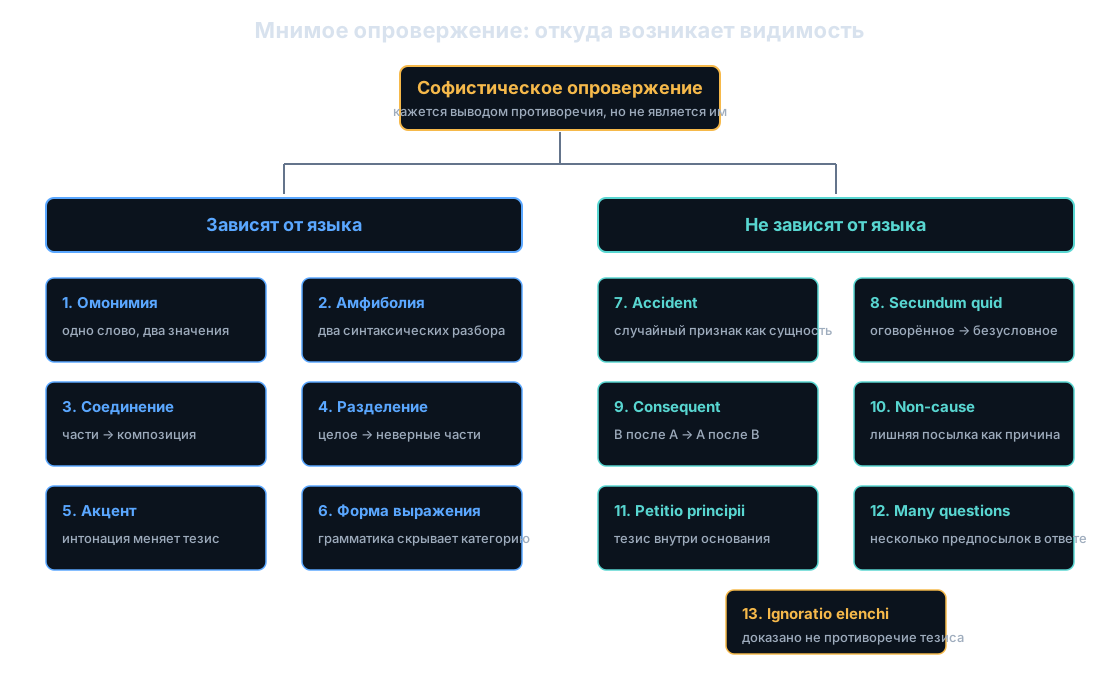
Aristotle divides sources of visibility into:
- language-dependent;
- language-independent.
The ’twelve or thirteen’ count differs: ignoratio elenchi can be read
as a separate fallacy or as a general explanation of why the others are
not a genuine refutation.
Chapter Rule
To refute a thesis, one must obtain its contradiction in the same sense,
relation, time, and modality. Everything else may be impressive, but
misses the target.
1. Why the language generates an illusion
There are more things and differences than there are separate words. Therefore, one symbol serves
multiple meanings, and similar constructs mask different logical forms.
Experienced analysis slows reading and restores the meaning of each occurrence.
2. Homonymy, or word ambiguity
One word is used in different meanings as if it were one term.
Все ключи должны храниться в vault.
`user_id` — ключ таблицы.
Следовательно, `user_id` должен храниться в vault.
Ключ means a cryptographic secret and a record identification attribute.
Schema
M₁ обладает P.
S есть M₂.
M₁ и M₂ обозначены одним словом.
∴ S обладает P.
Check
Replace each value with a distinct term. If the bridge disappears, there was an ambiguity.
When ambiguity is acceptable
In a metaphor, joke, name, or similarity study, if the transfer is not presented
as a necessary conclusion.
3. Amphiboly, or ambiguity of construction
Not a word, but the syntax allows for multiple analyses.
Сервис отклонил запрос пользователя с ошибкой.
Was the error a request, a user, or a service response?
Мы запретили экспорт менеджерам без MFA.
Have all managers without MFA been prohibited from export, or have managers been prohibited
from exporting objects not protected by MFA?
Check
Rewrite the sentence so that each modifier has one owner:
Менеджеры, у которых не настроена MFA, не могут экспортировать данные.
4. Word Connection
What is true about words or actions separately is taken to be true about
the combination.
Aristotelian examples depend on ancient Greek writing. Modern counterpart:
Пользователь может удалить черновик.
Пользователь может опубликовать черновик.
Следовательно, пользователь может удалить опубликованный черновик.
Two permitted actions individually do not guarantee a permitted composition
in any order and state.
операция A безопасна
операция B безопасна
∴ A;B безопасна
Check state transitions and non-commutativity.
5. Word splitting
The property of the whole expression is incorrectly distributed among parts or the grouping boundary is changed.
Система допускает «read only admin».
Is this a read-only administrator or reading only administrative data?
In code:
!user.isAdmin && resource.public
and:
!(user.isAdmin && resource.public)
are not equivalent. Parentheses — logical punctuation.
6. Stress and Accent
Meaning changes due to word emphasis, intonation, or typography.
Мы НЕ храним пароли пользователей.
Мы не храним ПАРОЛИ пользователей.
Мы не храним пароли ПОЛЬЗОВАТЕЛЕЙ.
The first version denies the action, the second may hint at hash storage,
the third leaves the storage of other secrets open.
The interface emphasizes:
- heading with a minor caveat;
- truncated chart axis;
- bold relative figure and an invisible absolute one;
- label “up to 2×”, when the typical result is 3%.
Emphasis is not always a fallacy. It becomes sophistic when it forces one to accept
a thesis other than what is actually confirmed.
Grammatical similarity gives different categories for the same.
Красный — цвет.
Красный флаг — предупреждение.
Следовательно, цвет — предупреждение.
Modern version — category error:
Где в кодовой базе находится бизнес?
A business process is implemented by many people, rules, data, and services; it is not
one object next to files.
Another example:
The model “knows” personal data.
The mechanism needs to be clarified: the data is present in the training set, generated from parameters, passed in the context, or available through a tool.
8. Accident: accidental property
A property of a thing and a property of a randomly associated feature are transferred onto each other.
Этот сервис критический.
Этот сервис написан на Java.
Следовательно, Java-сервисы критические.
The language is arbitrary with respect to criticality. It does not become a class criterion.
A rule that is usually true is applied mechanically to an exceptional case:
Публичность улучшает проверяемость.
Следовательно, секреты доступа тоже надо сделать публичными.
A useful principle does not apply to an object whose function depends on
privacy.
9. Secundum quid: from conditional to unconditional
The statement is true in some respect, but the caveat disappears.
Canary-релиз безопаснее полного релиза по blast radius.
Следовательно, canary-релиз безопасен.
It may be safer with respect to the scale of impact and unsafe with regard to
data leakage or irreversible migration.
Schema
P верно при условии C / по оси R.
∴ P верно безусловно.
Repair
Save the quantifier, period, baseline, and axis:
In this experiment canary reduces the number of simultaneously affected
users, but does not reduce the probability of irreversible schema damage.
10. Consequent: following-up reference
Aristotle notes: if A implies B, people accept as if B implies A.
Если процесс исчерпал память, его могли убить по OOM.
Процесс убит.
Следовательно, он исчерпал память.
There are operator signals, time limits, eviction and other reasons.
Modern forms:
- consequence assertion;
- universal judgment inversion;
- taking a diagnostic sign for a unique cause.
11. Non-cause: non-cause as a cause
In the Aristotelian context reductio one of the premises may be superfluous for
obtaining a contradiction, but it is declared the cause of impossibility.
Modern example:
Мы включили новую тему UI и новый алгоритм поиска.
Сборка упала из-за отсутствующего lockfile.
Следовательно, новая тема несовместима со сборкой.
The premise about the subject did not participate in explaining the contradiction.
In “Rhetoric” separately appears a more familiar fallacious empirical reason:
a sequence of events is taken for causality.
12. Petitio principii: presumption of the premise
A thesis is used as its own premise — directly or through renaming.
Почему этот стандарт обязателен?
Потому что его необходимо соблюдать.
Почему необходимо?
Потому что он обязательный.
Complex circle:
Сервис надёжен, потому что прошёл наш надёжный процесс сертификации.
Процесс надёжен, потому что допускает только надёжные сервисы.
Not every mutual support is a circle
Several independent measurements may converge. A circle arises when
the base ultimately gains power only from the original thesis.
13. Many questions: complex question
Several statements are packed into one question, and the short answer accepts them
all.
Вы уже перестали игнорировать требования безопасности?
Both “yes” and “no” accept the past neglect.
Engineering example:
Почему команда снова выбрала дорогую и ненадёжную базу?
Embedded:
- database is expensive;
- database is unreliable;
- the team has already made such a choice;
- it was precisely the team that chose it.
Repair
Split:
- Who made the decision?
- What is the cost of ownership?
- What reliability data?
- What alternatives were compared?
14. Ignoratio elenchi: ignorance of refutation
What is proven is not the contradiction of the original thesis, but something nearby.
Thesis:
For a specific stream idempotency is needed.
Answer:
Kafka — complex technology.
The answer may be true and important, but does not refute the requirement of
idempotency. It attacks one possible tool.
Modern relatives:
- thesis substitution;
- irrelevant conclusion;
- shifting to another issue;
- proving a weaker or different statement.
15. Unified Definition of Real Refutation
To successfully refute, a contradiction is needed:
- of the same object;
- of the same predicate;
- in the same relation;
- at the same time;
- in the same modality;
- based on accepted premises;
- without including the original thesis in the basis.
Example of an apparent contradiction:
— Система доступна.
— Неверно: вчера она падала.
«Available now» and «crashed yesterday» are compatible.
16. Diagnostic Table
| Fallacy family |
What looks the same |
What differs |
| Homonymy |
word |
meaning |
| Amphiboly |
sentence |
syntactic parsing |
| Composition |
permissible parts |
composition |
| Division |
expression |
boundary of parts |
| Accent |
text |
highlighted area |
| Expression form |
grammar |
category |
| Accident |
object and accidental feature |
essential relation |
| Secundum quid |
local truth |
unconditional truth |
| Consequent |
A → B |
B → A |
| Non-cause |
accompanying premise |
active cause |
| Petitio principii |
basis |
renamed thesis |
| Many questions |
one question |
several premises |
| Ignoratio elenchi |
striking conclusion |
required contradiction |
17. How to Respond to a Fallacy
- Restore the thesis.
- Fix the meaning of terms.
- Split the compound question.
- Return the qualifications and time.
- Show that the conclusion is compatible with the original thesis, if it is a substitution.
- Construct a counterexample.
- Formulate the nearest correct conclusion.
Do not respond with a label:
This is secundum quid.
Respond with a connection:
The data shows a reduction in blast radius, but the conclusion speaks about safety in general. The risk of irreversible migration was not measured by this metric.
18. Tasks
Define the Aristotelian mechanism and explain without naming:
- “All tokens are secrets. A design token is a token. Therefore, design tokens need to be rotated.”
- “The system is available 99.99% of the year, so it is available now.”
- “Have you already fixed another authorization error?”
- “After migration to Kubernetes, delivery sped up; Kubernetes speeds up delivery.”
- “This algorithm saves memory, so it is better.”
- “We are discussing the need for an audit.” — “But the audit will take a week.”
- “Each operation is allowed individually; therefore, a transaction consisting of them is allowed.”
Sources
What’s next
Aristotelian catalog gives the origin of many fallacies, but modern logic
more accurately describes the form of implications, disjunctions, quantifiers, and modality.
Modern Logic Fallacy Families