Academic and Engineering Walkthrough
In Chepanov judgment is a thought in which something is affirmed or denied;
expressed in words, it becomes a sentence. One judgment can be expressed
by different sentences:
Ни один запрос без токена не авторизован.
Все авторизованные запросы имеют токен.
Если запрос авторизован, у него есть токен.
In the selected model, these phrases may convey a similar relationship, although
the grammar differs.
Classic form:
S — subject, P — predicate, the copula connects or separates them.
2. Quantity and quality
Categorical judgments are classified by:
- quantity: general or specific;
- quality: affirmative or negative.
From here four forms:
| Name |
Form |
Example |
Modern notation |
| A |
All S are P |
All administrators have MFA |
∀x(Sx → Px) |
| E |
No S is P |
No plaintext password is secure |
∀x(Sx → ¬Px) |
| I |
Some S are P |
Some tasks are blocked |
∃x(Sx ∧ Px) |
| O |
Some S are not P |
Some events are not delivered |
∃x(Sx ∧ ¬Px) |
Letters originate from Latin affirmo and nego.
3. “Some” in logic
In classical logic некоторые S суть P means at least one.
The statement does not exclude that all S are P.
In colloquial speech:
Some tests have failed.
often hints at “not all.” This is a pragmatic implicature, not a logical
content. It is better to write explicitly in the specification:
Как минимум один тест упал.
Не все тесты упали.
Ровно 17 тестов упали.
4. Term Distribution
A term is distributed, if the judgment speaks of its entire extension.
| Form |
Subject S |
Predicate P |
Why |
| A: all S are P |
distributed |
not distributed |
said about all S, but not about all P |
| E: no S is P |
distributed |
distributed |
classes are completely separated |
| I: some S are P |
not distributed |
not distributed |
only about the intersection |
| O: some S are not P |
not distributed |
distributed |
selected S are excluded from all P |
This is a table from which syllogism rules are later derived.
Example A:
We talk about all SREs, but we do not claim that all engineers are SREs.
Therefore, SRE is distributed, инженеры is not.
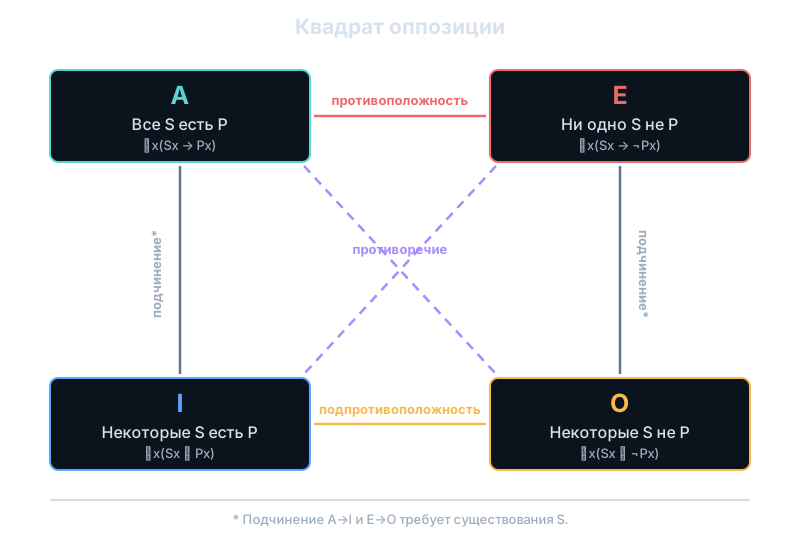
5. Square of Opposition
Contradiction
- A and O: “all S are P” / “some S are not P”;
- E and I: “no S is P” / “some S are P”.
Contradictory judgments cannot be simultaneously true and cannot be
simultaneously false.
Antonymy
A and E cannot be simultaneously true, but can be simultaneously
false:
Все задачи автоматизированы.      — ложно
Ни одна задача не автоматизирована. — тоже ложно
Part of the tasks is automated, part is not.
Subcontrariety
I and O in the traditional square cannot be simultaneously false if the
S class is non-empty.
Subordination
Traditionally from A to I, from E to O. This requires the existence of S.
6. Modern Caveat About Empty Classes
Let there be no unicorns:
Все единороги имеют MFA.        ∀x(Ux → Mx)
Ни один единорог не имеет MFA.  ∀x(Ux → ¬Mx)
Both universal formulas are vacuously true: there is no object violating either one.
Therefore, in modern predicate logic, traditional relations
of opposition and subordination do not work without an existential presupposition.
Reliable recording:
∃x Ux                 класс U непуст
∀x(Ux → Mx)           все U есть M
──────────────────
∃x(Ux ∧ Mx)           некоторые U есть M
Do not throw away the historical schema; remember its model.
7. Converse, Inversion and Contraposition
7.1. Converse
Changing quality and replacing the predicate with a complement:
Все S есть P.
Ни одно S не есть не-P.
The converse is valid for A, E, I and O.
7.2. Addressing
Swap the subject and predicate.
Ни одно S не P  →  Ни одно P не S.          E, корректно
Некоторые S есть P → Некоторые P есть S.    I, корректно
Simple invocation of A is incorrect:
Все кошки — животные.
Следовательно, все животные — кошки.
Traditional access A “with restriction” to Некоторые P есть S requires
the existence of S.
7.3. Contradiction to the Predicate
For A:
Все S есть P.
Все не-P не есть S.
In modern notation this is a counterposition:
∀x(Sx → Px) ⟺ ∀x(¬Px → ¬Sx)
But the converse statement P → S does not appear.
8. Conditional Judgments
Material implication is false only when P is true and Q is false.
| P |
Q |
P → Q |
| 0 |
0 |
1 |
| 0 |
1 |
1 |
| 1 |
0 |
0 |
| 1 |
1 |
1 |
Sufficient and Necessary
In P → Q:
- P is sufficient for Q;
- Q is necessary for P.
Если запрос успешно авторизован, его токен валиден.
A valid token is required in this model, but may be insufficient: account
is blocked, scope is invalid.
“Only If” and “If”
P, только если Q   = P → Q
P, если Q          = Q → P
P тогда и только тогда, когда Q = P ↔ Q
The word “only” changes the direction. It is a source of a huge number of errors in
requirements.
9. Delimiting Judgments
Modern disjunction is usually not exclusive:
True when both parts are true. “Either tea or coffee” in a menu often
excludes joint choice, but logical “or” is not required to do so.
Before using the disjunctive syllogism clarify:
- Are the options exhaustive?
- Are the options incompatible?
- Is it inclusive or exclusive “or”?
10. Modality
Chelpanov distinguishes:
- problematic: possibly P;
- assertoric: factually P;
- apodictic: necessarily P.
Modern notation:
◇P  возможно P
□P  необходимо P
Common fallacy:
P возможно.
Следовательно, P фактически.
And the reverse:
P фактически.
Следовательно, P необходимо.
The fact that the system has withstood the load now does not prove that it must withstand it in all permissible states.
11. Negation Scope
Compare:
Не все запросы успешны.
Некоторые запросы не успешны.
Ни один запрос не успешен.
The first two formulas are equivalent in a non-empty domain:
¬∀x Success(x) ⟺ ∃x ¬Success(x)
The third is much stronger:
Quantifier Order
For each PR there is some reviewer.
There is one person reviewing each PR.
Quantifier permutation turns distributed responsibility into
a single point of failure.
12. Laws of Thinking
In the traditional formulation:
Law of identity
The term should retain its meaning within the reasoning.
Law of non-contradiction
It is impossible to assert P and ¬P simultaneously in one respect, time, and sense.
The statuses “task is ready for development” and “task is not ready for production” do not
contradict each other: the relationships are different.
Law of excluded middle
In classical logic, a precisely defined statement has no third value.
This does not mean we know which side is true, and does not turn
any everyday pair into an exhaustive dilemma.
Principle of Sufficient Reason
It is often added to the three formal laws: a statement must have
a basis. This is a methodological principle, not a tautology of classical
calculus.
13. Common Judgment Level Errors
| Fallacy |
Example |
Fix |
| Condition inversion |
«without MFA you cannot enter» → «with MFA you can always enter» |
separate necessary and sufficient |
| Contradiction substitution for opposite |
«not fast» → «slow» |
allow intermediate values |
| Quantifier shift |
«everyone has a reviewer» → «there is a common reviewer» |
write out the order ∀/∃ |
| Incorrect negation |
¬∀ read as ∀¬ |
push negation through de Morgan |
| Existential import |
from «all S are P» to «some S are P» immediately |
prove ∃S |
| Ambiguous disjunction |
«either A or B» |
clarify completeness and exclusivity |
| Modal leap |
«happened» → «inevitable» |
separate P, ◇P, □P |
14. Engineering example: access policy
Requirement:
Only administrators with MFA can export data.
Possible readings:
Export(x) → Admin(x) ∧ MFA(x)
Administrator and MFA are required for export.
But incorrect:
Admin(x) ∧ MFA(x) → Export(x)
For legal matters, a role in a specific tenant, a work device,
no blocking, and separate agreement may be required.
Tests should check the original direction, not accidentally strengthened
equivalence.
15. Checklist
- Does the statement have a truth value at all?
- Is the quantity specified: all, some, exactly, most?
- Does “some” mean at least one or “not all”?
- Does the subject class exist?
- Is a necessary condition not mistaken for a sufficient one?
- Is the direction of “if” and “only if” preserved?
- Is the disjunction complete and correctly understands option compatibility?
- Does the negation have a clear scope?
- Has the order of quantifiers not been changed?
- Are the actual, possible, and necessary not mixed?
- Are the terms distributed correctly?
16. Tasks
- Formalize “every task has an owner” and “there is an owner of all tasks”.
- Deny without ambiguity: “all tests passed”.
- Determine what is necessary and sufficient in the phrase “access is granted only to employees after training”.
- Can “all critical incidents require postmortem” be reversed?
- Check the traditional square for the class “perpetual engines”.
Sources
What’s next
Now four forms of A/E/I/O can be combined in deduction. The next chapter
analyzes syllogism terms, figures, modes, distribution, and the method
of checking through diagrams.
Categorical syllogisms