Full academic and engineering walkthrough
The phrase “this is a fallacy” often ends a dispute exactly where the analysis should begin. One participant utters a Latin name, the second finds another name, while the original thesis remains unexamined. A catalog of fallacies without an argument model turns into a collection of labels.
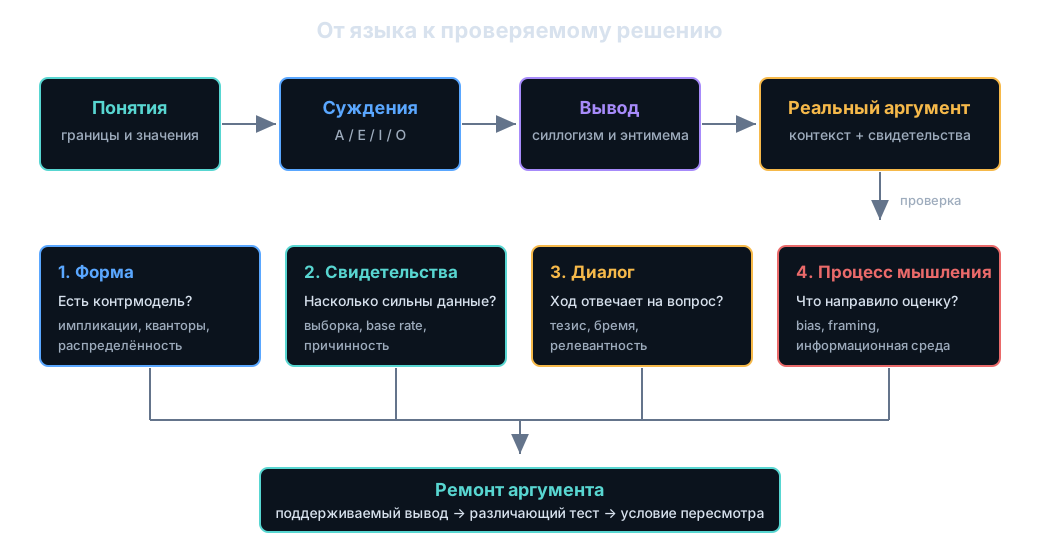
This course is built in reverse order. First, we learn to see the argument: what is being proven, on what grounds, and by what transition. Then we check the form, the quality of the grounds, the context of the dialogue, and only after that do we name the typical failure.
Course Rule
The fallacy name does not refute the argument. Specify the premise, inference, or
dialogue rule that is violated; present a counterexample; suggest a fix.
1. What logic checks
Let’s consider a short reasoning:
If the new version has reached production, the metric has changed. The metric
has changed. Therefore, the new version is already in production.
Here you can check different things:
- Term meanings. Is the same metric implied?
- Premise truth. Does a release always change the metric?
- Transition form. Does the release follow from the fact of change alone?
- Model completeness. Could the metric have been changed by data, seasonality, or another
service?
- Relevance. Does the conclusion address the discussion question?
The formal scheme is as follows:
Если P, то Q.
Q.
Следовательно, P.
This is a consequence claim. A counterexample is immediate: the metric could have changed for another reason. But detecting the form does not say which other reason is real. Logic discards an invalid inference; investigation establishes facts.
2. Four Different Failure Types
The conclusion does not follow from the premises even if they are true.
Все backend-разработчики пишут код.
Анна пишет код.
Следовательно, Анна backend-разработчик.
Anna can be a data scientist. The fallacy lives in the form, not in Anna’s profession.
2.2. Evidence Fallacy
The transition may be reasonable, but the data do not support the strength of the inference.
Пять знакомых перешли на язык X и ускорили delivery.
Значит, переход на X ускоряет любую команду.
The problem is in sampling, confounding factors, and external validity.
2.3. Violation of dialogue
A replica may be true but not fulfill the participant’s obligation.
— Почему этот доступ безопасен?
— А в соседней команде права настроены ещё хуже.
The neighboring team can be genuinely mistaken. This does not answer the question.
2.4. Cognitive Bias
This is not an argument form, but a systematic tendency of attention, memory or
evaluation.
После двух громких инцидентов руководитель переоценивает вероятность
повторения именно этого сценария.
Availability of examples explains the origin of the estimate, but by itself does not yet prove that the final decision is incorrect.
3. Validity, truth and persuasiveness
An argument has at least three independent axes.
| Axis |
Question |
Possible result |
| Validity |
Can the conclusion be false if the premises are true? |
valid / invalid |
| Soundness |
Are the premises true or acceptable? |
strong / weak grounds |
| Relevance |
Does the move advance the goal of this dialogue? |
relevant / disrupts the discussion |
A classic example of a valid but unsound argument:
Все базы данных умеют читать мысли.
PostgreSQL — база данных.
Следовательно, PostgreSQL умеет читать мысли.
The form is impeccable, the first premise is false. And conversely, a true conclusion does not
save a bad form:
Все квадраты — прямоугольники.
Некоторые фигуры — прямоугольники.
Следовательно, некоторые фигуры — квадраты.
A conclusion may be true in the world, but does not follow from the given premises.
4. From Aristotle to modern argumentation
timeline
title Линия курса
IV век до н. э. : Аристотель описывает термин, посылку и силлогизм
: «О софистических опровержениях» систематизирует мнимые доказательства
: «Риторика» связывает энтимему с убеждением
Античность и Средние века : развивается теория терминов и квадрат оппозиции
: диспут становится учебной технологией
XVII–XIX века : Бэкон исследует идолы познания
: Локк, Милль и Уэйтли расширяют анализ ошибок
: возникает математическая логика
1917 : Челпанов соединяет понятия, суждения, силлогизмы, индукцию и методы науки
XX век : Хэмблин возвращает ошибкам контекст реального диалога
: формируются неформальная логика и теория аргументации
XXI век : причинные модели, статистика и исследования когнитивных искажений
: аргументы проверяют в коде, данных, продуктах и AI-системах
Aristotle defines syllogism broadly: from the given premises, something different from them necessarily follows. His categorical syllogistics is the first systematic theory of such inference. In “On Sophistical Refutations,” fallacy is considered not merely as a bad line of formulas, but as a spurious refutation in a dialogue.
In Chepanov traditional logic unfolds from concepts and terms to
judgments, immediate inferences, syllogisms, induction, causality,
hypothesis, and classification. We preserve this pedagogical arc, but add
caveats from modern logic: empty classes, quantifiers, probabilistic inferences,
and the difference between formal fallacy and cognitive mechanism.
5. Anatomy of an Argument
It is convenient to reduce the argument to five fields:
Тезис:            что именно нужно принять?
Данные:           какие наблюдения или факты приводятся?
Правило перехода: почему данные поддерживают тезис?
Оговорки:         при каких условиях вывод ослабевает?
Альтернативы:     какое ещё объяснение совместимо с данными?
Example from code review:
Тезис:
    Этот кэш нужно оставить.

Данные:
    После его добавления p95 уменьшился на 30%.

Правило перехода:
    Если изменение устойчиво снижает пользовательскую задержку при приемлемой
    цене согласованности, оно полезно.

Оговорки:
    Замер сделан на одной неделе; выросли memory footprint и stale reads.

Альтернативы:
    Изменился профиль трафика; параллельно оптимизировали базу.
Now the argument becomes specific: the design of the experiment must be checked,
the cost of stale reads and alternative causes.
6. Universal Verification Protocol
flowchart TD
A["1. Найдите тезис"] --> B["2. Выпишите явные посылки"]
B --> C["3. Восстановите скрытые посылки"]
C --> D{"4. Следует ли тезис<br/>при истинных посылках?"}
D -- нет --> E["Формальный сбой:<br/>контрпример или модель"]
D -- да --> F{"5. Приемлемы ли<br/>сами посылки?"}
F -- нет --> G["Проблема свидетельств:<br/>источник, выборка, причинность"]
F -- да --> H{"6. Уместен ли ход<br/>в этом диалоге?"}
H -- нет --> I["Диалоговый сбой:<br/>тема, бремя, стандарт"]
H -- да --> J["7. Оцените силу вывода<br/>и сформулируйте оговорки"]
E --> K["8. Исправьте аргумент"]
G --> K
I --> K
J --> K
Step 1. Fix the thesis
Not “author against microservices”, but: “for this team a modular monolith is currently cheaper than microservices in terms of change costs”.
Step 2. Separate the premises
Fact, interpretation, forecast, and value — different types of premises:
- fact: «the team has four developers»;
- interpretation: «the domain boundaries are unstable»;
- forecast: «individual services will increase lead time»;
- value: «the speed of hypothesis checking is more important now than independent scaling».
Step 3. Complete the enthymeme
In real speech the transition is almost always omitted. Restore it with the strongest and most friendly version.
Step 4. Look for a countermodel, not a label
Show a possible world where the premises are true and the thesis is false. If such a world
is possible, there is no deductive necessity.
Step 5. Check the premises
Source, representativeness, measurement, baseline frequency, alternative
causes, conflict of interest, reproducibility.
Step 6. Return the context
The same move may be reasonable in an investigation and unacceptable in
a proof. Expert testimony is appropriate for a preliminary decision,
but does not replace data where data is available.
Step 7. Calibrate the power
«Proves», «supports», «increases the probability» and «is compatible with» are not
synonyms.
Step 8. Repair
A good analysis ends with an improved version:
In the observed period after enabling the cache, p95 decreased by 30%. We have not yet separated the cache effect from the parallel database optimization; an A/B test or gradual disabling is needed. We conditionally defer the decision until stale reads are checked.
7. How to take the course
| Block |
Chapters |
Result |
| Orientation |
00–00a |
argument check knowledge graph and live ideas history |
| Traditional logic |
01–05 |
concepts, judgments, syllogisms, enthymemes, Aristotle |
| Fallacy catalog |
06–10 |
form, relevance, language, causality, biases |
| Application |
11–12 |
engineering protocol and practice |
Don’t try to memorize the catalog in one pass. For each fallacy keep four
questions:
- What is the schema?
- What is the minimal counterexample?
- When is a similar move permissible?
- How to fix the argument?
8. Diagnostic Tasks
Exercise 1
After the team switched to Scrum, releases became more frequent. Therefore, Scrum always speeds up delivery.
Split the formal problem, the data problem, and the causal problem.
Exercise 2
This RFC is incorrect: its author has already missed two deadlines.
Can author information be relevant? What needs to be checked in the
RFC itself?
Assignment 3
Either we rewrite the system in a quarter, or we remain forever with legacy.
Which premise needs to be added for the disjunction to become exhaustive? Which
options are currently hidden?
9. Sources and Boundaries
No final catalog is “all fallacies.” A fallacy is a relation between
an argument, a standard of proof, and a context. Therefore, the course covers
major fallacy families and teaches how to generate precise diagnostics for new cases.
What’s next
First, we’ll trace the history of one idea: how an ordinary argument was learned to be broken down into premises, how logical form became algebra and an electric circuit, and how sets, symmetries, and categories added new ways to see structure. The chapter is available without mathematical background and contains separate applied perspectives for the researcher and the programmer.
How humanity learned to reason