
 YouTube
 Rutube
 VK Video
About this video
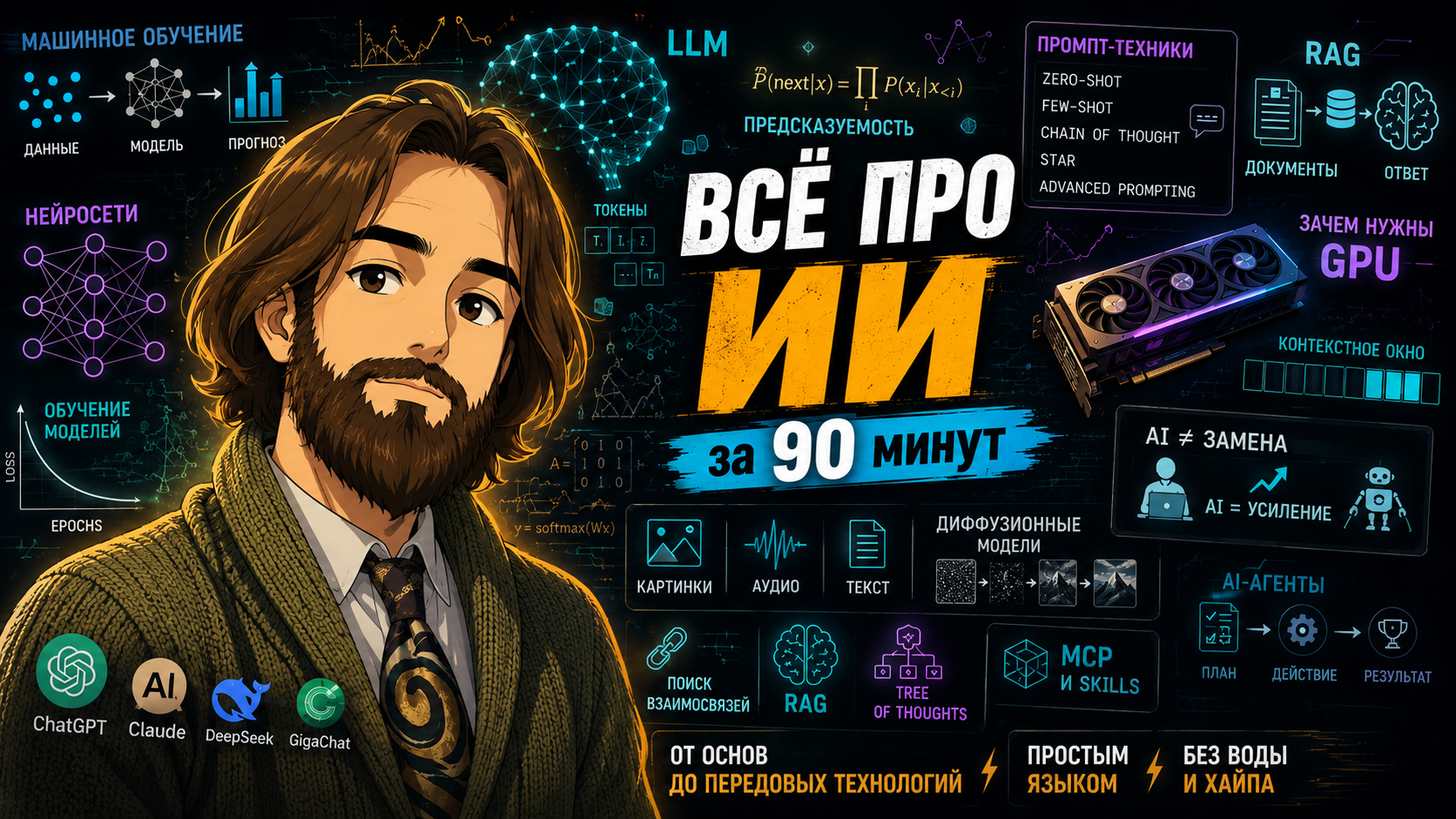
In this video:
- how LLMs, neural networks, and machine learning algorithms based on SBSE work
- why neural networks don’t “think”
- what tokens and context windows are
- how professional prompting works: ZS, FS, RCTF, ToT, CoT
- what RAG, MCP, and AI agents are
- why graphics cards are needed
- how images are generated
- and why AI is no longer “magic” but an engineering tool
The video will be suitable:
- for developers
- for those who are just starting to learn about AI
- and for everyone who wants to understand how it works without hype and marketing
📌 The video is based on a stream — without cutting out context and with explanations along the way.
- Twitch: https://www.twitch.tv/marat_zimnurov
- Telegram: https://t.me/digitable_blog
- Projects: https://digitable.ru/
- GitHub: https://github.com/the-homeless-god
Text version
The lecture has been broken down into a text track of 16 chapters — AI for Engineers: Fundamentals. It can be read without a player, searched for on the portal, and each chapter links to the relevant minute of this recording.
Timestamps
00:00 — Научный вопрос и предсказуемость
05:00 — Цепи Маркова
11:12 — Основные вехи ИИ
11:30 — SBSE
12:15 — Машинное обучение: картинки
15:36 — Машинное обучение: аудио
17:22 — Машинное обучение: текст
19:32 — Нейросети и обучение моделей
21:10 — Мы не знаем как выглядит мир
23:38 — Поиск взаимосвязей
30:13 — Большие языковые модели
32:15 — Как LLM понимает текст
34:20 — Могут ли нейросети думать
36:39 — Зачем нужны видеокарты
38:04 — Токеномика
43:32 — Промптинг
47:10 — STAR
53:23 — Польза промптинга
53:53 — Advanced Prompting
53:56 — Zero-shot prompting
54:54 — Few-shot prompting
56:06 — Chain of Thoughts
57:01 — Контекстное окно у LLM
58:02 — Как LLM помнит ваши запросы
01:00:30 — Диффузионные модели
01:01:58 — Как генерируются картинки
01:03:02 — Мотивация провайдеров на оптимизацию
01:06:05 — Chain of Verification
01:06:14 — Tree of Thoughts
01:09:00 — RCTF
01:14:51 — RAG
01:16:00 — Кому нужен промптинг?
01:16:29 — Кому ИИ может помочь?
01:20:55 — DeepSeek vs ChatGPT vs Gigachat
01:21:45 — Фрейминг и цензура
01:35:30 — SDD (Spec-Driven Development)
01:40:34 — Оркестрация
01:42:56 — Подводим итоги
01:46:57 — Самый важный подход для применения ИИ сегодня
01:49:49 — Коротко про MCP и skills
01:51:40 — Про замену специалистов на ИИ